Tuesday, March 9, 2010

It's Still Just Oatmeal

I've been hearing about steel-cut oats for a while now. They are more nutritious than rolled oats, have a more firm texture, and I had heard that they taste better too. I'm not a big fan of oatmeal. I will eat it, but that doesn't mean that I like it. It is mushy and slimy and doesn't taste good without brown sugar. I guess I thought that steel cut oats would magically not taste like oatmeal. I don't know how I delude myself into these ideas.

It's still just oatmeal!

Slimy, mushy oatmeal.

I had made a big pot, and after choking down a small bowl I seriously considered throwing the leftovers away. But if it's remotely edible I will not throw anything away, so into the fridge it went. And, surprisingly, the next day it was much better. It had firmed up and lost some of it's slime. The texture felt kind of like rice pudding. I almost enjoyed it. But it was still just oatmeal.

Bottom line: If you like oatmeal then you'll probably like steel-cut oats. If you don't like oatmeal, don't expect any miracles, you probably won't like steel-cut oats.

Wednesday, March 3, 2010

The Omnivore's Dilemma

When I finished reading The Omnivore’s Dilemma by Michael Pollan I was overwhelmed. There is so much information and emotion wrapped up in that book to adequately cover in a blog post, so I will only give you a few highlights, with my strong recommendation that you read it yourself. If you are at all interested in food, eating, the environment, or the moral implications of our decisions, you will find this book intriguing and enlightening.

As the menu planner and primary grocery shopper in my home, I am having a hard time doing those jobs in my post Omnivore’s Dilemma life. Michael Pollan forces us to think before we eat. I am fairly certain that this was the goal of the book- to make Americans think about where our food comes from. Here’s a hint: “the grocery store” is not the correct answer.

The correct answer is generally (but not always) “farms.” But not all farms are created equal. Most use chemical fertilizers and pesticides that strip the soil of its natural nutrients and poison the water supply. Some farms are “organic” by USDA standards (which some might consider too lenient) and still fewer are “organic” in a more traditional sense. Industry and fossil fuels have infiltrated just about everything we eat, from fruits, veggies, and grains, to beef, pork, and poultry. Industry has interfered with natural processes to turn a profit. Instead of cows grazing on ample pastures for a couple of years before being slaughtered, cows are fattened with corn over five months on a crowded feedlot. And the beautiful grasslands they used to graze on are transformed into more cornfields to fatten livestock and (unbeknownst to some of us) humans. It is more cost efficient for companies to raise livestock faster on less land, but the moral, environmental, and public health costs are often not considered. It needs to become profitable to raise crops and animals through healthy, natural methods and the only way this will happen is if people express demand for these products (or conversely, lack of demand in irresponsibly raised products.)

So how has this affected my grocery shopping?

I’ve stopped buying meat. I cannot endorse a system that crushes the true spirit of the livestock or that grossly pollutes the planet that I love and live on. This may be a temporary state of vegetarianism until I find a responsible local farmer, but even if or when that happens I know that I do not need to eat meat every day.

I’ve started buying some organic foods. Even though most organic foods that you’ll find in the store are what Pollan calls “industrial organic” he considers them a step above regular foods simply because that is a patch of land that does not have chemical fertilizers or pesticides on it. Apples are the number one fruit that we buy, so now I buy organic apples for twenty cents extra per pound. Call me crazy (Brett does) but I feel like they taste better! I also bought some Stonyfield organic yogurt on sale for cheaper than Yoplait! I love the packaging!

I’m still researching the best eggs and milk to buy. I just can’t bring myself to pay twice as much for organic milk if I’m not sure that my regular milk cows are being mistreated. As for eggs, I stood in front of the egg section for ten minutes trying to figure out what would be best. Cage-free? Organic? Vegetarian fed? I went with cage-free because I hated the image of laying hens crammed six to a cage so they can’t even move. According to the book, chickens left to their own devises like to eat grubs, so that’s why I didn’t go with vegetarian fed. I’m just not sure if that was the right decision.

The bottom line is: Read The Omnivore’s Dilemma! It will make you think about what you eat, pay attention to food in new ways, and seek change in this country’s agricultural habits.

Monday, March 1, 2010

Breakfast Burritos

Officially becoming a vegetarian has prompted me to think of new, tasty ways to get protein into my body. Truthfully, I probably wasn't getting enough protein anyway, but because my mom gave me a distinctly worried look when I told her about my plans to go vegetarian and because I love being responsible, I'm paying more attention to my protein intake.

Beans and eggs are two tasty, protein-rich options that so obviously lead to breakfast burritos. I've only had a breakfast burrito once, when I was tailgating at a Chargers game, but it was very good. I tweaked the formula just a little- subtract bacon, add pinto beans. And instead of eating them for breakfast, of course, we ate them for dinner.

The pinto beans were my favorite part. I sauteed some garlic in a little bit of olive oil, added a can of drained, rinsed pinto beans, and added a few shakes each of chili powder and cumin. Soooo good.

Brett decided to improvise homemade hashbrowns. He grated a potato, dried it off, and threw it in some hot oil. It was going pretty well... until the smoke alarm went off. We were on such a good streak too! I think it had been three or four months since it had gone off. When the hashbrowns were finished, they were very oily, but with a little bit of salt they tasted amazingly like the triangle hashbrowns they used to serve in the cafeteria my freshman year of college. Next time we'll probably just use the frozen kind, or research a few recipes.


I grated Jack cheese while Brett scrambled a few eggs.

Then we loaded up our tortillas. Mine closed up nicely, even though I forgot the salsa at first.

Brett's was a monster and wouldn't even close!


Monday, February 22, 2010

Vegetarian Adventure


I've been wanting to try being a vegetarian for a couple of years now and we are finally doing it... starting Wednesday. We have some meatballs in the freezer that we need to get rid of first.

I think we've gradually been heading in this direction because we stopped eating beef a long time ago, we don't eat meat every night, and we rarely eat big hunks of meat. This choice does eliminate a few favorites from our meal rotation and calls for some substitutions in others, but I think we can do it.

There are many reasons why people become vegetarians, but for me it is the mistreatment of farm animals. When I read Animal, Vegetable, Miracle last year my eyes were opened about the treatment of mass-produced turkeys. Turkeys are bred to have huge breasts, but they get so huge so fast that they can't even mate naturally. Similarly, chickens (as I saw on Oprah recently) get so big so fast that their legs can't even hold up their bodies, so they have no choice but to just sit in their own filth.

Cows are a whole different, horrible story. Right now I'm reading The Omnivore's Dilemma (which I will post about when I'm completely finished) and I just finished the chapter on factory farms. I knew it was bad, but I had no idea how bad. The cows are forced to eat corn when their bodies are naturally evolved to eat grass. This makes them sick, so they are also fed antibiotics. The herbivorous cows are also sometimes fed beef tallow (for fat) and chicken, pig, and fish meal (for protein.) They also stand and sleep in huge piles of their own waste. I could go on, but I won't. If there's anything I could encourage you to stop eating, it would be corn-fed beef.

We are still going to consume milk, cheese, and eggs, which has got me feeling a little hypocritical because I know some of those animals are mistreated too, but I can't give up those things. We've agreed to buy free-range eggs and become more aware of where our milk comes from and how those cows are treated.

I'm viewing this as a fun, new project and I'm hoping that it will work out. If you have any tips on being a vegetarian I would be happy to hear them! One great thing is that this choice won't interfere with dessert!

Wednesday, February 17, 2010

Orange Shrimp with Rice

I love it when I find a recipe that both Brett and I agree is a keeper. I found this recipe in the latest issue of Simple and Delicious magazine and they aren't kidding around; it really is simple and delicious!

I halved the recipe, but I will include the whole recipe here.

Cook rice.

Mix 1/2 a cup of orange juice with 1/4 tsp of cornstarch, 1/4 tsp of salt, and 2 T of fresh torn basil.

Saute 1 lb of raw shrimp (I took the tails off for faster consumption) and 2 cloves of garlic in 1 T butter and 1 T olive oil.

When the shrimp turn pink, stir in the orange juice mixture and let it thicken for about 1 minute.

Serve over rice.

Sooooo easy! All that probably took 10 minutes. And the best part is that it's really yummy. I've never really enjoyed fresh basil all that much, but it was fantastic in this. The orange flavor was very subtle and the garlic is so good. We will definitely be making this one again.

Friday, February 12, 2010

Sour Cherry Coffee Cake

Foolin' Around in the Kitchen is officially two years old! Thanks to everyone who reads my little blog!

In celebration of my "blogiversary" and Valentine's Day, I made a Sour Cherry Coffee Cake from Martha Stewart's Baking Handbook. This recipe has several steps but turned out very tasty.

I mixed up the batter and poured half of it in the bottom of a greased angel food cake pan (or as Martha calls it- a tube pan.) Then I placed cherries on top of the batter so that none were touching the pan. The rest of the batter went on top of that.

Then I had to make the streusel topping which turned out to be a little more complicated than I anticipated. Martha only includes a recipe that will make 4 cups of streusel and I only wanted 1 cup, so I had to fourth everything. You all know how sometimes halving things can go badly in my kitchen, so I made sure to write everything down. I ended up with some eighths and sixteenths but all in all it went well.

I sprinkled the streusel on top (it seemed like way too much but I went with it) and then put it in the oven.

When it came out of the oven it was not done, so I let it go five more minutes and it still wasn't done, so I let it go four more minutes and it was good enough. I declared it done.

After cooling for 15 minutes I inverted it onto a cooling rack with a baking sheet underneath just as Martha prescribed. Martha's a smart lady. Probably half of the streusel came off when I plopped the cake upside down onto the cooling rack. Then I carefully turned it back over with my hands.

I couldn't let all that topping go to waste, so I tried to scoop it up and put it back on top.

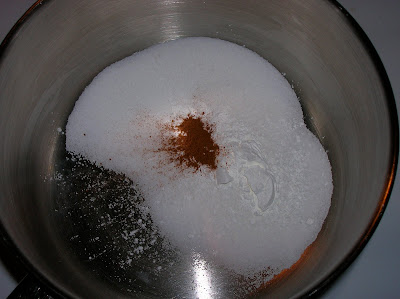
When the cake was completely cool I mixed up some milk glaze (1 cup powdered sugar and 2 T milk) and drizzled it all over the cake.

The cake was very good! I was a little worried about those cherries being too tart, but the cake is so sweet that it balances it out. The cherry bites are my favorite.

Monday, February 8, 2010

Apple Pancakes with Cider Syrup

Brett and I used to make pancakes all the time back in college. I pour and he flips. It's a great way to start the day. However, as much as we love breakfast foods, we rarely make them for breakfast. This was more of an afternoon snack for us.

This recipe is mostly based on a recipe in the Jan/Feb issue of Simple and Delicious magazine except that I refuse to use "complete pancake mix." I mixed up our usual pancake batter and added a little cinnamon while Brett grated up a Granny Smith apple to add to the batter.

Then I got to work on homemade syrup. This stuff is incredible! You've got to try it! In a small saucepan combine 1/2 cup sugar, 1T cornstarch, 1/8 teaspoon ground cinnamon, and 1/8 tsp ground nutmeg.

Then add in 1 cup of apple cider (preferably not expired) or apple juice.

Can you believe they still had this on the shelf? I bought it on Feb 1! I didn't even think to check the date on it. No wonder it tasted a little off. Live and learn.

Stir until it's all mixed and then turn on the burner to medium and keep stirring. When it's thick and bubbly turn the heat down to low, stir for a couple more minutes and then add 2 T of butter and 1 T of lemon juice. I kind of goofed up and added those last two ingredients immediately after lowering the heat and it didn't seem to matter. When the butter is all melted, remove it from the heat and let it sit while you cook the pancakes.

The grated apple gave the pancakes a mushier texture. Brett and I both agreed that next time we would just make regular pancakes. There's no need for the grated apple. The syrup is what makes these pancakes awesome!

I poured the syrup into a liquid measuring cup so we would have more control over pouring. I do have a fancy little syrup pourer somewhere in the storage closet. Maybe next time I'll think ahead and get it out.

This one is definitely a keeper!